
Ghana has secured significant international support for the conservation, management and sustainable development of its World Heritage properties following the country’s participation in the 48th Session of the UNESCO World Heritage Committee in Busan, Republic of Korea.

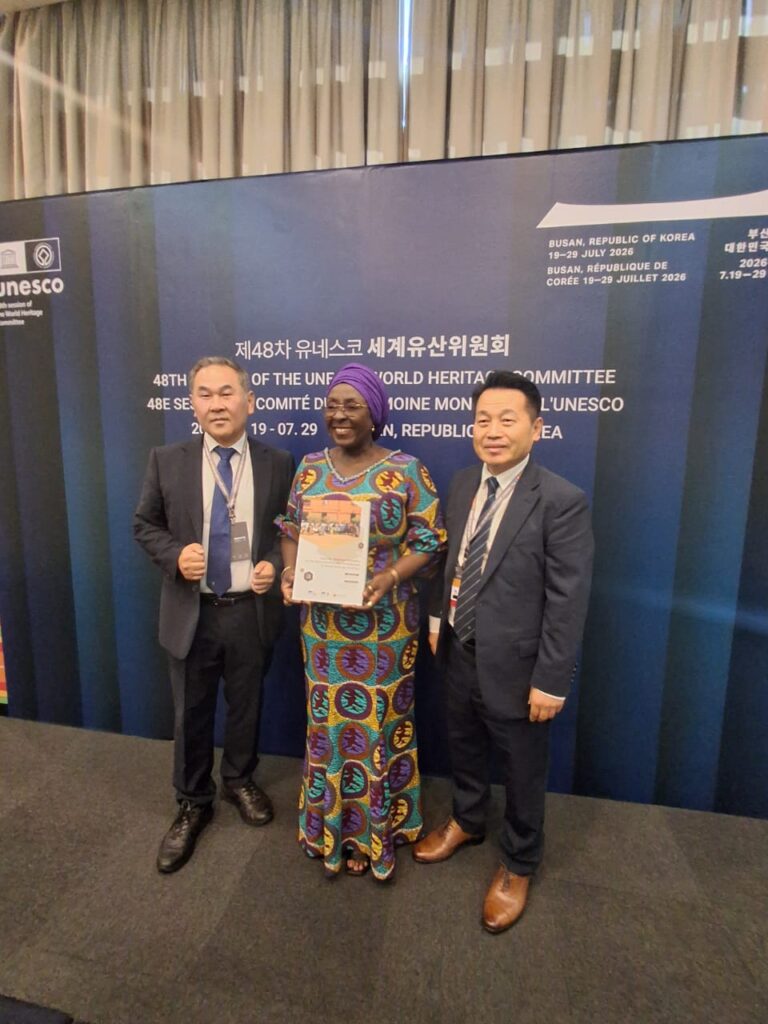
The Ghanaian delegation, led by the Minister for Tourism, Culture and Creative Arts, Hon. Abla Dzifa Gomashie, actively participated in the committee’s deliberations and held a series of high-level bilateral meetings with key international partners, resulting in major commitments to strengthen Ghana’s heritage conservation efforts.
The delegation met with the Africa World Heritage Fund (AWHF), the World Heritage Institute of Training and Research for the Asia and the Pacific Region (WHIPIC), the Assistant Director-General for Culture of UNESCO, and the Executive Director of the Korean National Commission for UNESCO. Discussions focused on enhancing Ghana’s heritage management systems, building technical capacity and mobilising resources to address the conservation needs of the country’s World Heritage sites, particularly the historic Forts and Castles.
Among the key outcomes of the engagements, the Africa World Heritage Fund agreed to support the Ministry of Tourism, Culture and Creative Arts and the Ghana Museums and Monuments Board (GMMB) through specialised human resource development and capacity-building programmes to strengthen heritage conservation and management.
WHIPIC also committed to providing technical training for officers of the Ghana Museums and Monuments Board in heritage site interpretation and visitor experience management, an intervention expected to improve the presentation and appreciation of Ghana’s heritage sites.
In a major boost to Ghana’s preservation efforts, the Korean National Commission for UNESCO pledged US$3.5 million to support restoration works at six selected Forts and Castles. The funding will complement the Government of Ghana’s implementation of UNESCO recommendations and contribute to the long-term conservation of these globally significant monuments.
As part of the visit, Hon. Gomashie, accompanied by Ghana’s Ambassador to the Republic of Korea, H.E. Kojo Choi, attended the graduation ceremony of six Ghanaian officials who successfully completed a specialised capacity-building programme organised by the Korean National Commission for UNESCO in Seoul.
The beneficiaries, drawn from the Ministry of Tourism, Culture and Creative Arts, the Ghana National Commission for UNESCO, the Ghana Museums and Monuments Board and the Environmental Protection Agency, received intensive training on managing the impacts of climate change on cultural heritage sites.
The Minister congratulated the graduates on their achievement and expressed Ghana’s appreciation to the Korean National Commission for UNESCO for its continued investment in strengthening the country’s heritage management capacity. She noted that the programme would help equip Ghanaian professionals with the technical expertise needed to build resilience against the growing threats of climate change to the nation’s World Heritage properties.
Hon. Gomashie also expressed Ghana’s gratitude to the Government and people of the Republic of Korea, UNESCO, the Africa World Heritage Fund and WHIPIC for their continued partnership and confidence in Ghana’s commitment to safeguarding its cultural heritage.
She reaffirmed the Government’s commitment, under the leadership of President John Dramani Mahama, to protect and promote Ghana’s rich cultural heritage as a driver of tourism development, education, job creation and sustainable national development.
The Ghanaian delegation comprised Mrs. Meredith Naakai Lamptey Addy, Ghana’s Permanent Representative to UNESCO; Prof. Usman Damba, Secretary-General of the Ghana National Commission for UNESCO; Mr. Kwesi Essel Blankson, Acting Executive Director of the Ghana Museums and Monuments Board; and Mr. Divine Kwame Owusu-Ansah, Director for Culture and Creative Arts at the Ministry of Tourism, Culture and Creative Arts.